



– Advertisement –
Saint Lucia
– Consultant herpetologist Dr. Lenn Isidore is leading a pilot assessment of the current distribution, ecology, biology, and management needs of the Saint Lucia Fer-de-Lance (Bothrops caribbaeus), to inform the Forestry Department’s management approaches, supporting sustainable resource use and enhancing public safety.

“This project revolves around two main components- human safety and snake conservation,” said Dr. Isidore. “We want to train a few key persons in each of the at-risk communities on how to safely catch the snakes, safely contain them and relocate them. We’re hoping to foster co-existence by empowering people on what to do if they encounter a snake. We also want to get a better understanding of the biology, ecology of the species, how it behaves, when it is most active, what time of year it moves and which features in the landscape it prefers.”
The seven-month consultancy is an updated distribution assessment of the Saint Lucia Fer-de-Lance delivered to inform management approaches by the Forestry Department to facilitate sustainable resource use and enhance public safety.
Activities of this pilot initiative will include:
- Conducting updated field surveys to map population distribution and habitat range.
- Reviewing and validating existing management guidelines for the species.
- Training relevant agencies and community stakeholders on safe handling, risk management, and field assessment protocols.
- Providing evidence-based recommendations to update the national Fer-de-Lance Management Plan.
The Department of Forestry is eager for this component of the ABS Project to help them better conserve the endemic species and mitigate human-snake conflict.
Assistant Chief Forestry Officer Pius Haynes said, “We have the notion that the encounters of Fer-de-Lances are indeed increasing and so it has become important for us to undertake a scientific study so that we would understand the distribution of the species islandwide.”
National Project Coordinator, Beana Joseph said this consultation will be the foundation for Saint Lucia’s pharmacological venom research.
“Later on within this project we will be focusing on how to extract the venom from the Saint Lucian Fer-De-Lance for further analysis, research, as well as analyzing the potential medicinal and pharmaceutical benefits from this venom.”
The other pilot consultancy, Portfolio of Blue/Green Economic Opportunities aims to identify and develop viable products and services that utilise Saint Lucia’s native plants, animals, and micro-organisms for sustainable commercialisation. Led by Business Development Consultant, Kareem Guiste, activities over a six-month period will include:
- Conducting a market assessment to identify potential products or services derived from genetic resources with high commercial potential.
- Analysing supply chains, value addition opportunities, and potential benefits to local communities.
- Developing a portfolio of investment-ready business cases.
- Engaging stakeholders, including private sector and community-based enterprises, to promote uptake and partnerships.
Joseph said this project component “will feed into a Small Grant Mechanism to disburse USD$100,000 to five local businesses in Saint Lucia that are focused on using local biological resources, either plants, animals, micro-organisms in producing a product.” These selected businesses will also receive capacity building and training in equitable benefit-sharing.
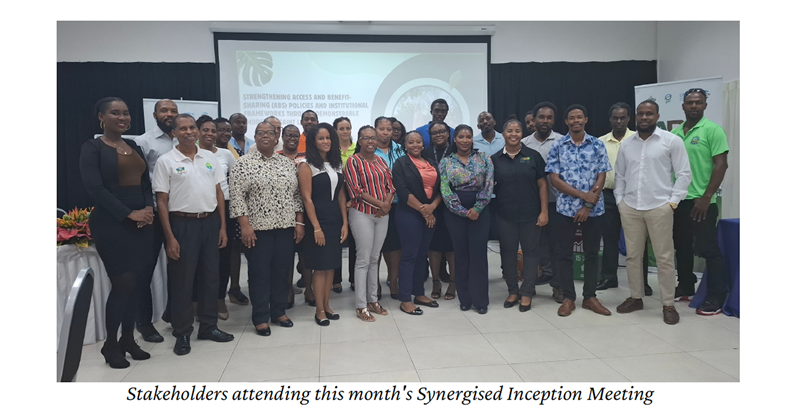
At the Inception Meeting, Permanent Secretary in the Department of Sustainable Development, Anita Montoute said: “Both consultancies will help us test and demonstrate what operationalizing ABS can look like in practice—while maintaining the guiding principles of equity, benefit-sharing, and respect for traditional knowledge. Saint Lucia is home to a wealth of biodiversity—some of it not only unique to our island but more importantly, are under severe threat . As a matter of urgency, protecting and sustainably utilizing these resources requires more than conservation; it demands inclusive frameworks that recognize the value of our genetic resources and the traditional knowledge associated with it.”
PS Montoute thanked ABS Project Financier, Global Environment Facility (GEF), Implementing Agency, United Nations Environment Programme (UNEP) and Executing Agency, International Union for the Conservation of Nature (IUCN) for continued support into this consultancy phase.
Saint Lucia’s ABS Project works to implement the goals of the Nagoya Protocol, an international agreement on Access and Benefit Sharing (ABS) that ensures the fair sharing of benefits arising from the use of genetic resources.
– Advertisement –