


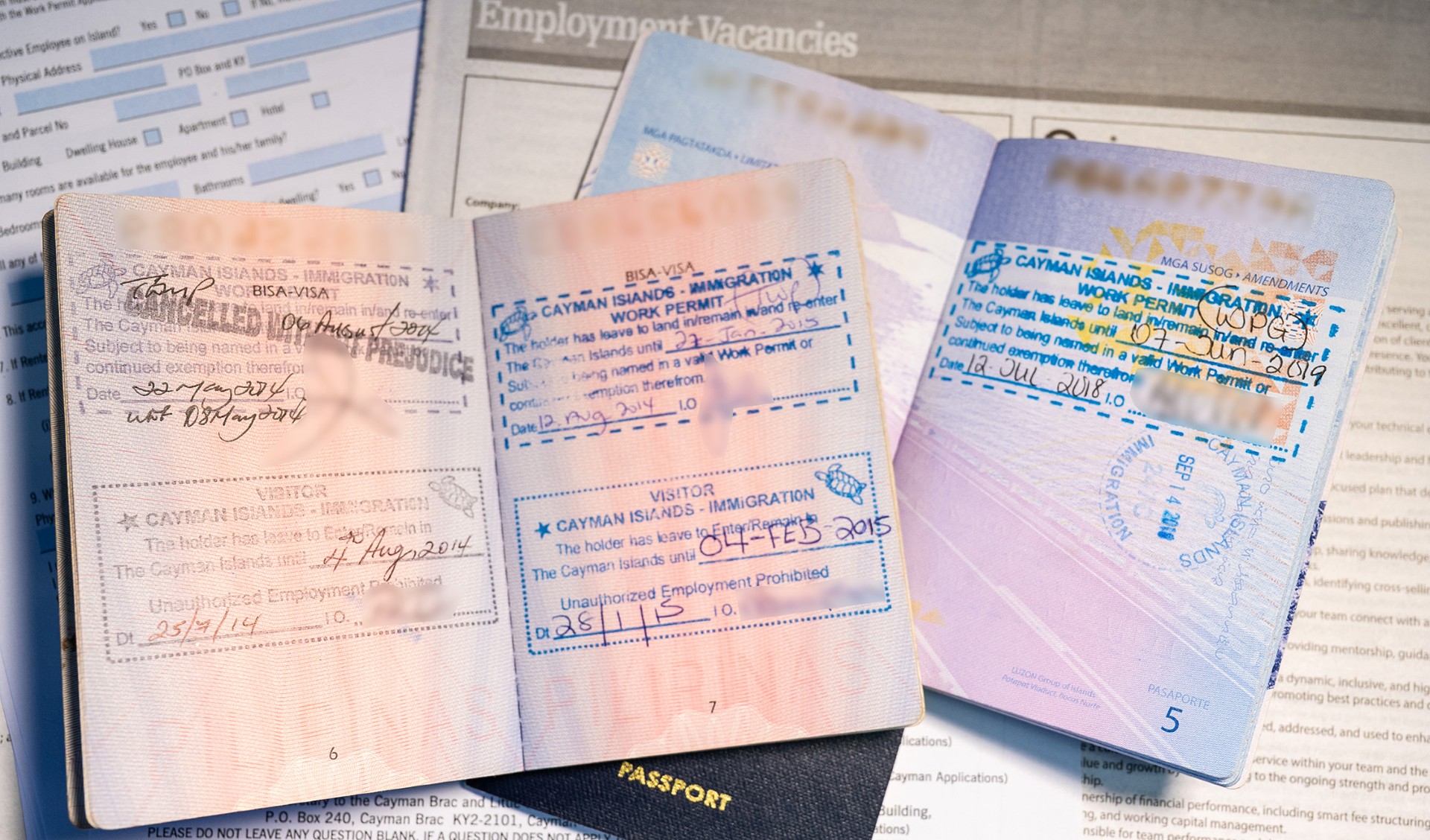
When ‘Arun’ collapsed in the doorway of the Victory Tabernacle church in George Town, it marked the beginning of the end of one of the worst periods of his life.
He had arrived in Cayman from rural India, having borrowed against family gold and land deeds, to pay his passage.
The 26-year-old, speaking to the Compass under a pseudonym on condition of anonymity, handed over more than US$10,000 to an agent in his home country. He believed he had bought his way into a stable job in the Caribbean.
Instead, he arrived in Cayman to find there was no work. He ended up destitute, sleeping rough on Public Beach and surviving on slices of bread and peanut butter.
“It was the toughest time in my life, but I could not give up,” he said. “If I failed, my family would lose everything.”
Pattern of complaints
A Compass investigation suggests he is potentially one of hundreds of migrants who have been scammed out of their savings and offered work permits in Cayman for jobs that don’t exist.
Samples of complaints filed with Cayman’s Workforce Opportunities & Residency Cayman agency point to a pattern of desperate young men and women, most commonly from India, Nepal or the Philippines, who have arrived in the territory with temporary permits to work at local businesses.
When they arrived on island, the complaints allege, they found the job and sometimes even the company did not exist. They end up going door to door at businesses looking for work.
Michael Myles, the minister for Caymanian employment and immigration, said the practice has become increasingly common.
“This is widespread in our country and has been allowed to happen in successive governments who knew it was happening,” he said, adding that WORC had developed a “high risk register” to help address the issue.
WORC Director Jeremy Scott did not respond to questions for this article.
Several business owners confirmed they were inundated with applications from people who had arrived in Cayman in this manner.
“As far as I can tell, it is rife. At one stage, I was getting six applications a day from people telling me they had arrived on a permit and there was no work for them,” said a security firm owner.
In many cases, he said, the applications and résumés were virtually identical.
Another business owner – a long-time Cayman resident and prominent member of the growing Nepalese community – said they were concerned that the practice was giving the country a bad name.
“It makes us very sad, because Nepal has always been known as a good country with nice people,” she said.
Attorney Desiree Jacob, who is of Filipino heritage and has worked with the local Filipino association to provide pro bono legal advice, said the use of black market labour brokers was a growing issue that warranted further investigation.
“We’re seeing this quite a bit … largely with Nepalese and also the Filipino community. This is not a story that is unique just to the Cayman Islands, but it is currently happening here and it’s happening with multiple nationalities.”
‘I didn’t know where Cayman was’
Arun arrived in 2024 with four other men, also from India, having paid a fixer to secure a job and a room in the Cayman Islands. Other people he knew had used the same consultancy to find jobs in Malta, Dubai, the US and Canada.
He handed over his medical records, police clearance documents and copies of his passport, along with the cash to secure his permit.
“I didn’t even know where the Cayman Islands was,” he admitted in an interview with the Compass.
He arrived on the island with just a few belongings and $800 in his pocket, expecting to start work the next day.
But when he turned up at the address he had been given for the janitorial firm where he would be working, he was told there was no job. There was also nowhere for him to stay and he resorted first to sneaking into the rented room that two of his fellow travellers had secured and sleeping on the floor, and later, when that scheme unravelled, he was homeless.
“I slept for two weeks on the public beach. I had no food, except bread, water and, sometimes, peanut butter. Because of the mosquitoes, I could only sleep two hours each night,” he said.
Going back to India was not an option for financial reasons, and the broker who had facilitated his travel to Cayman had stopped taking his calls.
“I didn’t have any money. I didn’t have any job. I didn’t have a place to stay. I didn’t have anybody. I was just believing that I cannot give up,” he said.
Pastor steps in
His ordeal reached its nadir outside the Church of God of Prophecy, Victory Tabernacle, on Eastern Avenue, when he passed out from exhaustion and hunger. Pastor PJ Lawrence, who speaks Telugu, Arun’s native language, was called to the scene by church members.

“He had not eaten for a long time,” Lawrence said.
“He was going from shop to shop and office to office looking for a job and, literally, because he was walking in the hot sun on the road, he reached the church steps and he just fainted.”
The pastor took him to the immigration department where he claims officers admitted the permit was “not legitimate”. He said he highlighted his concerns that this was an organised scheme involving several other migrants, and officers told him they were aware of the issue but not who was responsible.
“That Sunday I was preaching at Elmslie Church and I narrated everything I am saying to you now. I told the congregation very openly that this is clearly a racket,” said Lawrence.
He said the congregation members were shocked and people gave money, shoes and clothes to help Arun survive until he could find work.
Lawrence says Arun was not alone. Eight men arrived in Cayman from India with his cohort on two flights around the same time in late 2023. Three were turned back at the airport, while five, including Arun, were left stranded in Cayman.

Businesses see the fallout
His account matches a growing set of allegations about companies obtaining work permits for migrants who are then told to find employment on their own.
A written complaint to WORC earlier this year described how Nepali workers were brought in under cleaning-company permits, only to be left “walking up and down West Bay Road looking for work”. One woman was said to have held three permits in less than a year while “job-hopping”, and résumés were described as “almost identical” across multiple applications.
The complaints suggest a vast disparity in what workers have paid to come to Cayman, with some said to have shelled out as much as US$30,000 and others as little as $600, according to different accounts.
A Cayman security firm owner told the Compass he had been deluged with pleas from stranded workers.
“The résumés are all the same,” he said. “They’re being done en masse, and it’s just their personal details, their photograph, that’s different. They’ve all worked for the same companies, same sort of periods of time. I mean, it’s ridiculous.”
He said paperwork filed with immigration showed some had originally applied with résumés showing janitorial experience, yet the résumés he had received suddenly claimed a long career in security work.
“These companies bring them in, tell them there’s no job, and give them three months to find something else,” he said. “Then, they’re knocking on my door begging for work. I don’t want my company anywhere near that.”
‘This is human trafficking’
A prominent member of the Nepalese community in Cayman said they were concerned the practice had been going on for a long time. They said many young people from Nepal were arriving on the islands with temporary permits and looking for work on the street.
“In Nepal, they are telling them it is the American dream and people will do anything … even sell their house for the American dream. Agents tell them Cayman is ‘pretty much like America’.”
They said they had heard of people being charged as much as $30,000 for a package that included travel, rent and permit. They believe there are Nepalese fixers in Cayman involved – making links to agents back home and paying companies in Cayman to help get the permits.
“This is pretty much like human trafficking,” they said.
Permits for women typically come from salons, spas and nail bars. For men, it is cleaning and janitorial companies. They said many of the new arrivals were very young and unskilled, and sometimes offered to work for free initially if companies could get them a work permit and train them.
Data from the Department of Commerce and Investment suggests there is a proliferation of those types of companies in Cayman, potentially making fraudulent or ghost companies harder to spot. There are currently more than 800 cleaning and janitorial firms and almost 300 beauty spas, barbershops or salons with registered trade and business licences on the August list published by DCI.
An established pattern
Attorney Jacob agrees that it is a form of trafficking.
She said there is an established pattern involving at least three players taking a cut of the profits.
There is the fixer in Cayman connecting rogue recruitment agents or individuals in their home country with businesses in Cayman that are prepared to apply for work permits for jobs that don’t exist.
She said the agents in the source country usually targeted people in desperate situations with lower education and language barriers who were willing to pay significant sums in the belief they would be able to get a job.
Jacob noted that the migrants are often “willing victims”, at first, handing over cash without checking if they have a legitimate job or even knowing exactly where they are going.
“Some people do know that it’s too good to be true but they’re willing to do it because they are desperate.
“It is like a person from Cuba getting on a boat hoping that they’re going to land somewhere. That is how dire their situation is in their homeland, that they are willing to risk coming to another country under these conditions.”
She warned that the risk of exploitation only increases once they arrive in Cayman and get pulled into a shadow economy where they are afraid to report abuse.
‘Selling a permit is not legal’
Despite that, she says the real legal culpability and moral responsibility lies with the businesses and the fixers in Cayman.
“Selling a work permit is not legal. Paying for your own work permit is not legal.”
In the case of Filipino workers, she said, paying for your own travel is also not legal under that country’s laws for migrant workers.
Jacob believes the extent of the issue could warrant a proactive investigation. But she said a few quick fixes to the law, such as insisting that people arriving on a work permit have a return ticket and a legal contract of employment that is enforceable in the courts would be a good start. She also supports amendments to limit job hopping among permit holders in the first 12 months of their employment.
She said the Filipino community is pushing for change because legitimate workers don’t want to see compatriots exploited, or for their community to be tarnished by association.
“We have been on a campaign telling people: ‘Do not tell your friends and family to come here unless they have a contract that protects them, unless the person trying to recruit them is also legitimate and authorised, and you have done your due diligence’.
“This is part of an awareness that we raise. Yes, your situation in the Philippines may be dire, but it cannot be more desperate than now being in the Cayman Islands with no relatives, no money, no food, no home, unable to speak the language and maybe in jail.”
Richard Barton, a criminal defence lawyer who formerly served as chair of the Business Staffing Plan Board, said the board’s remit extended only to businesses with more than 15 staff on work permits. He said he had not encountered a scam like that during his tenure and if behaviour like that had been detected, the application would have been denied and WORC’s compliance division alerted.
“Invariably, what is described amounts to criminal conduct. It is vital that the perpetrators are identified, whether here or abroad, and held to account,” he added.
A global problem
Collectively, the allegations paint a picture of a thriving black market for labour in Cayman, with workers paying thousands to overseas agents for jobs that do not exist, then arriving legally in Cayman only to be abandoned.
For the workers, it means debt, the risk of exploitation and, in some cases, destitution. For Caymanians, it means increased competition from stranded jobseekers who will work for almost nothing.
The challenge has parallels with a wider global issue. Arun believes the company he went through in India took money from at least 30 others from his home town around the same time to link them with work in different destinations. Across Asia, the Middle East and the Americas, labour brokers charge exorbitant fees to secure fraudulent permits and abandon workers on arrival.
A report by the International Labour Organization highlights that workers should not be charged “directly or indirectly” any fees or related costs for their recruitment.
It warns of a growing global concern around the issue.
“An estimated 20% of all forced labour cases emanate from debt bondage, most of which occurs through the payment of exorbitant recruitment fees and related costs,” the report states.
For Arun, however, things have ended well. Thanks to the kindness of the church members who found him and the congregation at Elmslie Church, he was able to get back on his feet and is now in steady work. He has since repaid his loans and rebuilt his life.
But he is conscious that others are being conned every day and that more people are still arriving in Cayman and being left to fend for themselves without work, money or means to get home. He is concerned that others continue to fall into the hands of unscrupulous agents, selling a dream of well-paid work in western countries like Cayman.
“When I see them, I try to help,” he says.
Compass journalist Simon Boxall also contributed to this article.