


Realtors remain sanguine as Parliament approved a stamp duty increase for land and properties worth $2 million and above that takes effect on 1 Jan. 2026.
On 14 Nov., Minister of Finance and Economic Development, Rolston Anglin, announced that stamp duty on property and land worth $2 million would increase to 10% from 7.5%. On 12 Dec. that measure was passed by Parliament and the regulations approved on 15 Dec. confirmed the change will apply from 1 Jan. 2026.

The short timeframe between the announcement and the implementation, makes it difficult to gauge the market reaction.
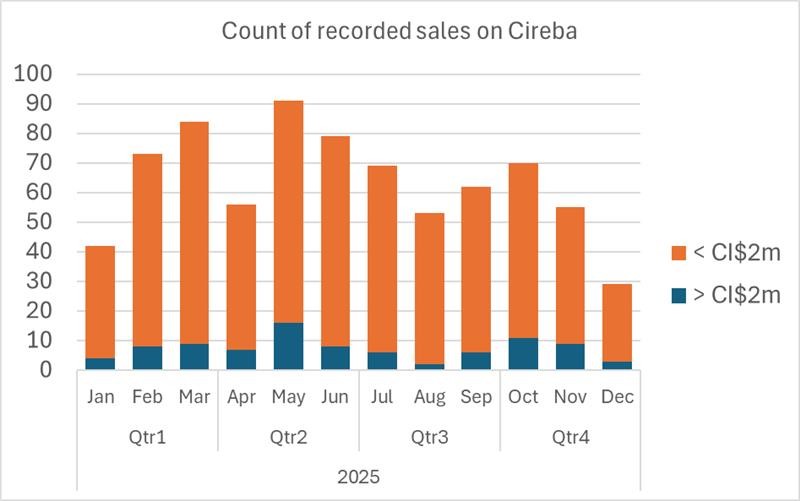
Provenance Properties analysed data from the Cayman Islands Real Estate Brokers Association (CIREBA) and found no clear impact on sales, following the 14 Nov. announcement.
“We see an average of around seven or eight CI$2m + sales every month on CIREBA,” said a Provenance Properties spokesperson. “There were nine sales in November, four of which took place prior to the announcement and it is likely that the remaining five would have already been under contract. Midway through December, we have only recorded three sales over $2 million this month.”
Of course, sales data is a lagging indicator that might not capture an uptick in transactions that are about to close. But Provenance’s analysis of properties placed ‘under contract’ with CIREBA doesn’t show a strong trend either.
“Seven went under contract in November and there have been seven so far just over halfway through December,” said the spokesperson. “The latter is encouraging but could just as easily be attributed to seasonality rather than market response to the imminent stamp duty changes.”
One realtor reported something different.
“As soon as investors and potential purchasers found out that stamp duty is going up to 10%, anyone who was thinking about purchasing – or sitting on the fence – has made a decision,” said Cayman realtor and RE/MAX broker, Kim Lund.
“A number of them have decided to proceed because they want to lock in the 7.5% rate. So, we’ve got a surge of activity right now and as soon as 10% is in effect, it’s very likely that surge will fall off.”
Short-term impact
When the increase was announced, some questioned the amount it would raise and the purpose of those funds.
Anglin revealed the government would “earmark” 1% of the 2.5% stamp duty increase –which is the equivalent of 40% of the additional revenue –
“for housing and housing-related improvement projects and [house] building for Caymanians”.
So, if in 2026 the stamp duty increase raises the $11.7 million predicted by Anglin, then $4.7 million would be used for this government housing spending.

There had also been some doubt among realtors about whether the new measures would generate the additional revenues predicted by government. A short-lived 10% stamp duty introduced in 1995 failed to produce the additional revenues expected. But, after assessing reactions, real estate professionals told the Compass that Cayman’s market is different this time around.
“I think this will be a win for government,” said Lund, who was a realtor in the 1990s. “We have a situation where we have several large condominium developments completing in 2026. These people have no choice as they are already locked in and they will have to pay the 10% duty. In the 1990s we didn’t have that situation and people could choose to wait.”
Luxury developments that will close next year include the Grand Hyatt, Watermark, Dolphin Point Club and Serrana.
Long-term impact
While this current increase may be well-timed for the latest projects, it would lead to less government revenue in the long-term if it cut future demand for luxury housing.
While justifying the increase to Parliament, Anglin claimed that Cayman real estate was the world’s best-performing asset class over the past decade. That could be debated, but Anglin’s central point is that luxury Cayman real estate can now be treated as a high-performing asset class with international buyers and therefore sustain a higher stamp duty.
“The market has changed dramatically,” said Lund. “The number of overseas investors and purchasers here is far greater than it was in the 1990s [and] we’ve attracted a higher-end market than we had.”
“For international buyers assessing the Cayman Islands’ tax and cost efficiency, I don’t expect this one-off tax to have a significant impact in the longer term,” said Andrew Gilbert, chair of the Cayman Islands chapter of the Royal Institution of Chartered Surveyors.
While some of the additional revenue measures, such as the increase to driving licence fees, have proved controversial, real estate professionals are mostly optimistic about the stamp duty increase.