


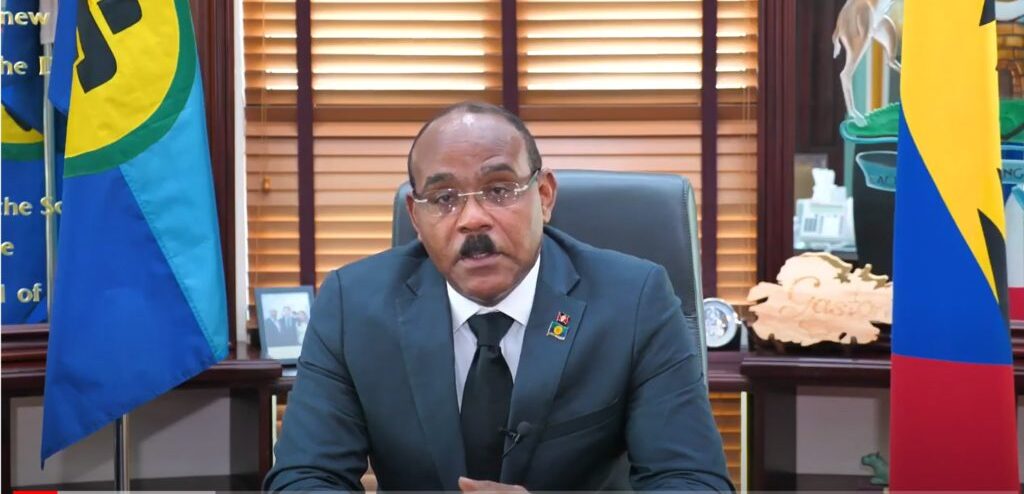
The Government of Antigua and Barbuda has recently addressed concerns regarding its cooperation with the United States concerning third-country nationals, including refugees.
In an official written media statement, the twin-island government, led by Prime Minister Gaston Browne, emphasized that it is committed to transparency, accuracy, and maintaining public confidence by clarifying the facts surrounding this issue.
It goes on to explicitly state that there has been no secret or legally binding agreement between Antigua and Barbuda and the United States.
Government authorities explained that what exists is a non-binding Memorandum of Understanding (MoU), proposed by the United States as part of its global effort to share responsibility for refugees already residing within its borders. they added that this proposal was extended to over one hundred governments worldwide, including several within the Caribbean Community (CARICOM), inviting consideration of a flexible, non-binding arrangement.
According to the release, to address the humanitarian crisis of facilitating the largest refugee population in the world, the U.S. has sought international cooperation to share the burden, requesting other nations accept non-criminal refugees in a manner that is safe and lawful.
Reportedly, many countries have already agreed to this non-binding arrangement–with Dominica’s Prime Minister, Roosevelt Skerrit, making the announcement in the country yesterday, though details have not yet been made public.
However, the release claims this does not impose legal obligations on Antigua and Barbuda, nor does it set quotas or require automatic acceptance of individuals. It also said that the agreement can be terminated at any time solely at Antigua and Barbuda’s discretion.
Addressing claims suggesting that Antigua and Barbuda has been coerced into a secret or binding agreement, the Antiguan administration deems them incorrect and misleading.
The statement goes on to clarify that under this understanding, the country retains complete sovereignty, including the right to reject any individual proposed by the U.S. The decision-making process involves careful, case-by-case review, and no persons with criminal backgrounds would be accepted.
Furthermore, the potential acceptance of third-country nationals is reportedly strictly limited, with an upper cap of ten individuals annually, subject entirely to the government’s discretion. There is no surrender of control over borders, no transfer of authority, and no compromise of national security.
Importantly, Antigua and Barbuda says it is not agreeing to accept deportees or act as a holding ground for individuals rejected by other nations.
“The Understanding relates only to lawfully screened third-country nationals, including refugees already present in the United States, and only where Antigua and Barbuda is fully satisfied—on the basis of intelligence vetting and national security assessments—that acceptance would pose no risk to the country or its people,” continues the statement.
Making it clear that the initiative was authorized by the Prime Minister and Attorney General as a diplomatic gesture, they emphasize that it was not a concession, nor an attempt to trade or harbor individuals unlawfully. Instead, say officials, it was “a measured diplomatic gesture, taken alongside many other responsible states, while preserving Antigua and Barbuda’s full discretion and control.”
In the broader context, Antigua and Barbuda government stated that it is actively engaged in discussions with the United States on various issues, including restoring normal visa issuance and renewals for its citizens, as well as technical matters related to biometric standards and international identity verification.
In its view, such cooperation on these issues exemplifies the routine, good-faith interactions that characterize international relations, reinforcing that such steps do not compromise national sovereignty or security.
“Antigua and Barbuda remains a sovereign state, fully in control of its decisions and its borders. The Government will continue to act prudently, transparently, and in the best interests of the people of Antigua and Barbuda,” concluded the release.