



– Advertisement –
By Loshaun Dixon
St. Kitts and Nevis on Monday, January 12, joined member states of the Organisation of Eastern Caribbean States (OECS) in the ceremonial opening of the 2026 Law Year of the Eastern Caribbean Supreme Court (ECSC). The regional observance was hosted by the Commonwealth of Dominica under the theme “The ECSC: Justice that Endures — Anchored in Independence, Strengthened through Trust.”
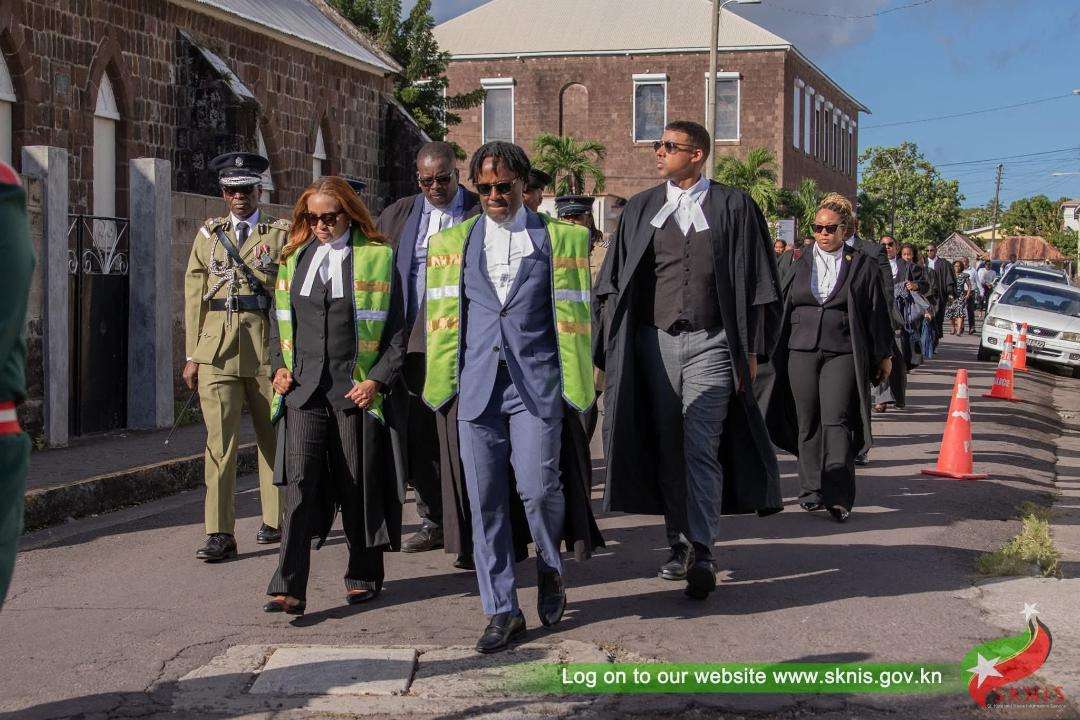
Locally, the proceedings began with a church service at Wesley Methodist Church on Seaton Street, Basseterre, at 7:45 a.m., followed by a ceremonial procession to the S. W. Tapley Seaton Court Annex on East Independence Square Street. A Special Sitting of the Court commenced at 10:00 a.m., marking a return to in-person, synchronised observances across the ECSC’s nine jurisdictions after several years of centralised or virtual formats.
Acting Chief Justice, the Honourable Margaret Price-Findlay, delivered the feature address live from the Court in Dominica. In her remarks, she reaffirmed the judiciary’s commitment to independence and the importance of public confidence in the administration of justice.
“Justice that endures is not merely about the application of law; it is about anchoring our decisions in true independence while building and sustaining the trust of the people we serve,” she said.
Addressing contemporary challenges facing the region’s courts, the Acting Chief Justice emphasised the ECSC’s resolve to uphold fairness and transparency.
“In an era of evolving challenges, the ECSC remains steadfast in its resolve to deliver justice fairly, impartially, and transparently, ensuring that our courts continue to be pillars of stability and fairness across the region,” she stated.
Looking ahead, Justice Price-Findlay outlined initiatives aimed at strengthening access to justice, particularly for vulnerable groups.
“We are committed to expanding specialised training and establishing family courts where needed, to better address the unique needs of vulnerable groups and deliver justice with sensitivity and expertise,” she noted.
Her address highlighted ongoing efforts to modernise the delivery of justice, including enhanced judicial training in family law and plans to introduce family courts in certain jurisdictions, such as Dominica, as part of a broader push towards more responsive and accessible adjudication.
Established in 1967, the Eastern Caribbean Supreme Court serves as the superior court of record for six independent OECS states — Antigua and Barbuda, Dominica, Grenada, St. Kitts and Nevis, St. Lucia, and St. Vincent and the Grenadines — as well as three British Overseas Territories: Anguilla, the British Virgin Islands, and Montserrat. The annual opening of the Law Year renews the judiciary’s pledge to uphold the rule of law, protect fundamental rights, and support good governance across the subregion.
– Advertisement –