


By Latrishka Thomas
The jury in the Nigel Christian murder trial sat through four closing speeches on Wednesday before being told they will hold the fates of three men in their hands when deliberations begin next Monday.
This followed weeks of testimony, DNA evidence, and bitter disputes over planted evidence and police integrity.
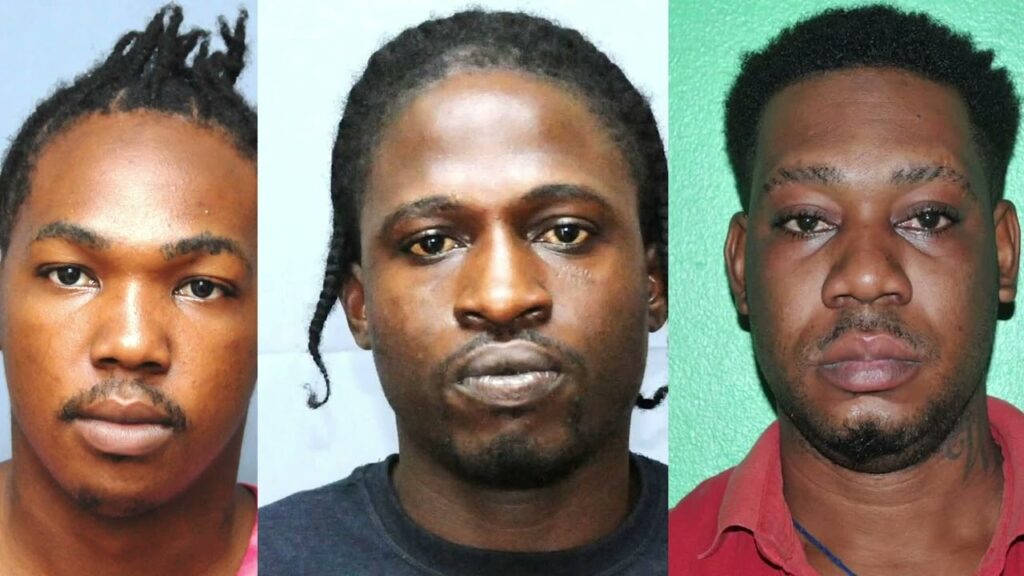
Saleim Harrigan, 35, Wayne Thomas, 33, and Lasean Bully, 35, are on trial before Justice Rajiv Persaud, accused of abducting Christian from his McKinnons home at gunpoint on the afternoon of July 10, 2020, and shooting him dead on a dirt road in Thibou’s later that same day. All three have pleaded not guilty and have therefore been on trial since February 19.
The Crown’s Closing
Director of Public Prosecutions Clement Joseph led the Crown’s closing, urging the jury to consider the totality of the evidence against the accused. He submitted that the elements of murder had been established — that a living man had been unlawfully and intentionally killed — and that what remained for the jury was to determine whether it was the three accused who were responsible.
Joseph opened by framing the proceedings in weighty terms: “All of us have a judgement day. Judgement comes sometimes on earth or in the afterlife. Today is the judgment day of the accused.”
He pointed to the testimony of a key witness — a driver who told the court he transported the three accused on the day of the killing, watched them abduct Christian at gunpoint, and later collected them after coming upon Christian’s body. “If the key witness had not come forward, we would not be here today,” Joseph told the jury, noting the driver had admitted to his own involvement by driving the men. Of the driver’s own reckoning, Joseph said: “His judgement day is ahead but it’s not for you to decide.”
Joseph also addressed the human toll of the killing, telling the jury that Christian’s mother had experienced the serious emotional loss of a son “who cared and loved her dearly enough to move in to take care of her.”

The DPP referenced FBI cellular mapping evidence, displaying a chart of call records showing calls made from Harrigan’s phone to the driver during a period Harrigan claimed they had not been in contact. He also addressed a photograph of Christian’s truck found on Harrigan’s phone, which he said had been received in May and deleted in June — before the murder and before police took possession of the phone — arguing the evidence did not support the defence’s claim that it had been planted.
Joseph directly challenged the defence’s position that evidence had been planted. “Antigua police is the slackest police on this earth if they are going to plant evidence and not fill it up with DNA,” he said. He argued that if police were planting evidence they would have included more, and that any DNA contamination would have occurred at Perry Bay where items were all in a bag together, not afterward.
Joseph pushed back on the defence attorneys’ efforts to implicate additional persons in the killing, saying: “They [the defence] are like accountants who are just adding people but not subtracting their clients.”
On the proliferation of conspiracy theories advanced by the defence, Joseph remarked: “We have so many conspiracy theories in this case that it’s not funny anymore. Everything was a plant. Agriculture. Agriculture. Agriculture.”
Joseph dismissed suggestions that a meeting between the key witness and senior police officers at a politician’s office had any bearing on the case. “Does this meeting have anything to do with whether these three men committed the crime of murder? No,” he said.
He also addressed the bag recovered at Perry Bay — identified by Christian’s girlfriend based on its features and the tea bags and Swiss chocolate found inside — noting that the girlfriend had also recognised the bag’s interior floral pattern, not only its contents, contrary to what the defence had implied.
The Defence Closings
Wendel Alexander, counsel for Harrigan, opened the defence’s closing arguments by asking the jury to consider who had a motive to kill Christian, noting he had been investigating Customs fraud at the time of his death. “You cannot have a police force within a police force,” Alexander told the jury, adding that the meeting at the politician’s office with senior police officers should not have taken place.
Alexander questioned whether a series of events surrounding the driver were coincidental — that he left work early, that his vehicle broke down requiring him to rent a car around the time of the killing, and that he returned the rental shortly after the murder.
He described the key witness as a “pathological liar” and said the driver had “many hats — a source, a suspect, a person of interest, a witness” — but that nobody had referred to him by what Alexander called the most fitting title: “Judas Iscariot,” which he described as that of a double agent.
He challenged the driver’s claim that he had lent a sweater and shirt to two of the accused, noting the driver had never mentioned this to police. “If the key witness can participate so much and lie so much, what wouldn’t he do?” Alexander asked.
On the cell tower evidence, Alexander told the jury that while he did not dispute the telephone records, the technology could only place a phone in a general area. He referenced a separate case where a murderer had been tracked to near his exact location from a single call, arguing that in this century investigators should be able to obtain more precise data.
Alexander reminded the jury that even if someone lies, it does not mean they are guilty, as people lie for many reasons, and urged them to apply their common sense. He also noted that none of the camouflage attire had DNA of the accused on it, and that the bag used to link Christian to the Perry Bay items could be purchased on Amazon. He further noted that the bag was never mentioned by the driver or anyone else as having been brought into the vehicle on the day of the killing, and called it a “dry bones investigation”.
Michael Archibald, counsel for Bully, told the jury the key witness had put forward “a carefully crafted story” and submitted that the driver had been offered his freedom in exchange for implicating the three accused at the meeting in the politician’s office. “He said he didn’t cut a deal but that’s the biggest deal that he could have cut — to remain on the road,” Archibald said, calling it the driver’s incentive to lie.
Archibald questioned why, if the driver had been feeding information to police about a murder plot in advance, nothing had been done to prevent the killing. He questioned how a bag allegedly belonging to Christian and used for an entire year contained none of his DNA. He also highlighted the absence of forensic evidence from the vehicles the men were said to have travelled in suggesting that in the July heat they must have been sweating and some part of them must have been touching something.
Archibald described the case as an incomplete puzzle. “The story is the box and the evidence is the pieces of the puzzle and now it’s time to put them together — pieces are missing,” he said, adding: “There are too many unanswered questions.”
On the key witness’s performance throughout the proceedings, Archibald said: “The driver is so good an actor…. that was the biggest show he ever put on in his life because it would guarantee his freedom.”
Sherfield Bowen, counsel for Thomas, told the jury there were no calls linked to his client and called the connection between the bag and the accused “a lie from the chambers of hell”.
He described the tea bags and Swiss chocolate said to have been found inside as “a project from the agricultural science department — it was planted,” pointing out that the police photographer had testified those items were not present when he documented the bag’s contents, and that Christian’s mother and brother had not recognised the bag.
Bowen argued the procedure used to have Christian’s girlfriend identify the bag was irregular. He told the jury that normally a witness would describe an item to police, who would then present it for confirmation — but said the girlfriend was shown the bag first, and then described what she saw.
He raised a suspicious sequence around the timing of events on the day of the murder, noting that the driver returned the rental car at 6:16 pm — but the crime had been committed at around 5:48 pm, and the driver said he walked from the rental place in Radio Range to retrieve his own car at Ottos. Bowen also alleged that police had misrepresented their attempts to recover footage from a DVR and said it was never taken to the FBI.
Bowen suggested the lead investigator had been steered away from her instincts, telling the jury she had been directed to follow the key witness’s account. He noted that a well known business man had been named as having ordered the killing, and that a convicted murderer had reportedly facilitated it, yet neither had been charged. “They don’t want the truth,” Bowen said.
He also pointed out that a senior officer who had placed the driver in a cell and questioned him as a suspect was subsequently cut out of the investigation.
Bowen called the key witness a “self-confessed pathological liar” and said the Perry Bay evidence had been contaminated with items from Cassada Gardens to manufacture a connection. “… this case is intentionally weak because the real evidence would lead to the real perpetrator,” he told the jury.
He also noted that an Assistant Commissioner of Police had been receiving updates from the key witness throughout the investigation, yet Christian had never been placed under protection.
“When the protector becomes a predator, from whence are we going to be protected?” Bowen asked.
Closing his address, Bowen told the jury they could not convict unless the evidence made them feel sure, and called on them to do the right thing. He specifically addressed individual jurors by number, commending their attentiveness and urging them to carefully consider all of the evidence, including the demeanour of those who testified.
All three defence attorneys maintained throughout the trial that the driver and others were the true perpetrators and had falsely implicated the accused.
The trial has been presided over by Justice Rajiv Persaud. The Crown has been led by DPP Clement Joseph and Crown Counsel Curtis Cornelius. Bully is represented by Michael Archibald, Thomas by Sherfield Bowen, and Harrigan by Wendel Alexander. The judge is expected to sum up the case before the jury retires to deliberate on Monday.