


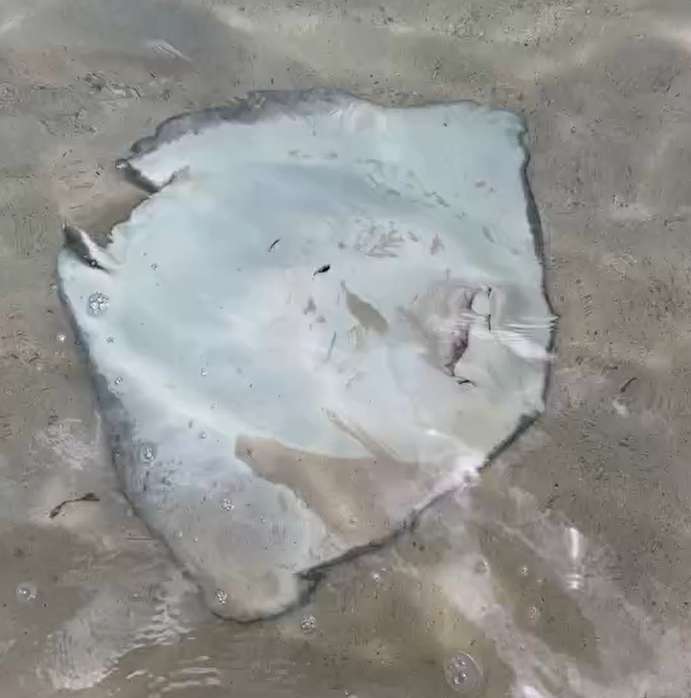
As video on social media circulates of a southern stingray found killed by Barefoot Beach in East End over the weekend, environmental officers are reminding the public of the species’ protected status.
Shark project officer at the Department of Environment, Johanna Kohler, explained that, based on the animal’s visible injuries, it was clear that the stingray had been killed by a person rather than through natural circumstances.
Stingrays are members of the same subclass as sharks, and all members of this subclass are protected in Cayman waters under the National Conservation Act.
“If they are caught, they should be released unharmed back into the water,” she said.

DoE Chief Conservation Officer Mark Orr said some fishermen worry they will be stung trying to release a ray, but fishing hooks can be safely removed with a pair of pliers.
“If you are on a boat, simply lift part of the head of the ray out of the water and use the pliers to pull the hook out,” Orr said.
“If you are on shore, you can also pull the ray up the beach or to the edge of the ironshore and again, use the pliers to remove the hook.”
Orr said that another option is to safely cut the line as close as possible to the hook. When fishing, he advised using non-stainless-steel circle hooks because they rust away more quickly.
Diversity of rays in Cayman
Kohler said that in addition to the southern stingray, which is commonly seen at Stingray City, three other types of rays can be found in Cayman waters, including the yellow ray, the spotted eagle ray and the lesser electric ray.
As its name suggests, the lesser electric ray can deliver a shock, but it is only rarely seen in Cayman. In March, Harvey Sizemore, who works as divemaster at the Brac Scuba Shack, came across one while diving off a reef in Cayman Brac.
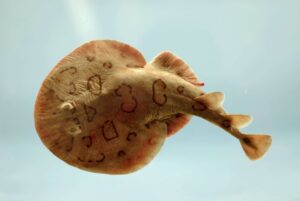
Prior to this sighting, there had been no recorded sightings of an electric ray in Cayman waters in ten years.
Kohler explained that it is not currently known if the southern stingray population in Cayman is increasing or decreasing.
“The Guy Harvey Foundation monitors the number of rays at Stingray City and the Sandbar, but DoE is not currently assessing the wild numbers for rays,” she said.
The Guy Harvey Foundation, which researches the local population of rays that interact with people, found that following a period of decline during the COVID-19 pandemic, there were 105 stingrays counted at the Sandbar and Stingray City in 2024. The foundation estimates that each stingray at these sites brings in a staggering $500,000 per year in tourism revenue.
Wildlife awareness
Kohler is asking members of the fishing public to also be aware that at this time of year, small sharks and some larger female sharks can be found very close to the shore.
“It is the pupping season for sharks between May and the end of August, so if you are fishing and you see a shark close to the shoreline, we encourage you to pull in your lines and let the sharks swim past the area,” she said, adding that this will reduce the chance of an accidental catch.
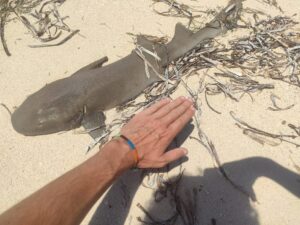
Recently a small nurse shark was also found washed up on the coastline in the Frank Sound area.
The Department of the Environment said there were no signs of injuries and it appeared this the young shark had died of natural causes.
According to Kohler, “As soon as the baby sharks are born, they are on their own and they have to learn to find food, so they typically start feeding close to the water’s edge and they don’t always make it.”