


 There is something humbling about stepping into a celebration that is not your own.
On Sunday 1st March 2026, I did just that when I attended the Holi festivities hosted by the Guyanese Association of Anguilla at The Green Space. As someone who has always been curious about cultures beyond my own — from Japanese and Korean traditions to the diverse customs of African nations — I have long believed that music, language and ritual are doorways into understanding. Often, I find myself listening to foreign-language music more than English, drawn not necessarily by comprehension of every word, but by rhythm, emotion and story.
So when my work brought me into closer contact with the Guyanese and Indo-Guyanese community here in Anguilla, I found that same curiosity stirring again.
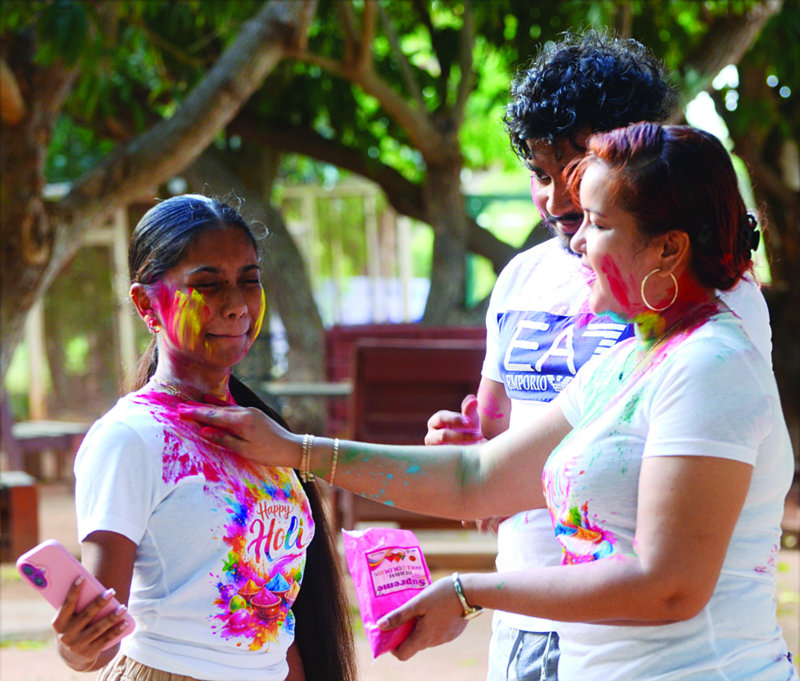
 The grounds of The Green Space were transformed into a kaleidoscope of colour and culture as families, friends and well-wishers gathered for the observance. The afternoon began reverently with the reciting of a Hindu hymn, grounding what would become a lively celebration in its spiritual roots. A poem dedicated to the festival followed, its lines simple but brimming with meaning:
“Colour flies high in the sky.
Red and yellow and green and blue.
Holi brings joy to me and you.
Splashing colours water spray.
Celebrating in a fun filled way.
Holi is the time to share.
Love, laughter and colour everywhere.”
As an outsider, I stood listening, realising that while the powders and water guns would soon dominate the landscape, Holi — known in Guyana as Pagwa — is first and foremost a story. It is one of the most vibrant festivals in the Hindu calendar, observed on the full moon of the month of Phalguna, typically in late February or March. It marks the arrival of spring and symbolises the triumph of good over evil. In Guyana, where descendants of Indian indentured labourers preserved centuries-old traditions, Holi is not only a Hindu observance but a national holiday embraced across ethnic and religious lines.
Mrs. Deoranie Bharrat, addressing the gathering, explained the significance of the day with warmth and clarity. “Holi is a time of colours and songs and music. So wherever you go at this Holi time, there will always be dancing, singing and lots of colours. This is another occasion that brings all our people together — all ethnic groups, all ages — and we celebrate and we have fun together.”
She pointed to the many attendees dressed in white. “Usually we wear white. Then we powder each other with coloured powder or spray coloured water.”
White, I quickly learned, is intentional — a blank canvas ready to be transformed. It felt symbolic, too. We arrive as we are, and we leave marked by shared experience.
Mrs. Bharrat briefly shared the legend at the heart of Holi — the story of the tyrant king Hiranyakashipu, who believed himself invincible after securing special boons, and his devoted son Prahalad, who refused to stop worshipping God. Despite repeated attempts on the boy’s life, he was protected, while the king’s sister Holika — who tried to burn him in a fire — perished instead. Ultimately, God appeared in the form of Narasimha, half man and half lion, destroying the king and affirming the triumph of good over evil, commemorated through the bonfire known as Holika Dahan. She also referenced the lighter tale of Lord Krishna playfully colouring Radha’s face, a story which inspired the joyful tradition of smearing one another with bright powders as a symbol of love and unity.
By Sunday afternoon’s end, those legends had leapt from story into lived experience. Clouds of powdered red, yellow, blue and green rose into the air. Children shrieked with laughter as they chased one another with water guns. Adults also surrendered to the inevitable, embracing colour with the same enthusiasm.
As someone not born into the tradition, I was struck not by exclusion but by invitation. No one insisted that you believe. No one demanded that you convert. Participation was offered, not forced. Respect was mutual. Tables were lined with traditional vegetarian dishes and “sweetmeats” — beloved Guyanese confections — reinforcing Holi’s spirit of hospitality and abundance.
What stayed with me – aside from the powder on my clothes and skin – was this: we often live within the comfortable echo chamber of our own culture. Most of us are Anguillian. We, rightfully, stand proud and true to our own customs. Yet within this small island lives a tapestry of people carrying histories from elsewhere — Guyana, China, Dominican Republic, America and beyond.
You don’t have to adopt another’s religion or practise their rituals to appreciate them. But stepping outside our cultural bubble, even briefly, opens dialogue and further builds community. It fosters understanding. It reminds us that identity is layered and that heritage travels with people wherever they settle.
Watching the Guyanese community celebrate Holi so vibrantly, thousands of miles from ancestral homelands, was a testament to resilience. Traditions have survived oceans, generations and change. They have adapted without losing their heart.
Holi in Anguilla is more than an imported celebration. It is an expression of belonging — both to heritage and to this island. And sometimes, the most meaningful way to grow is simply to step into someone else’s colour for a while.
By Janissa Fleming